Predepression Tea
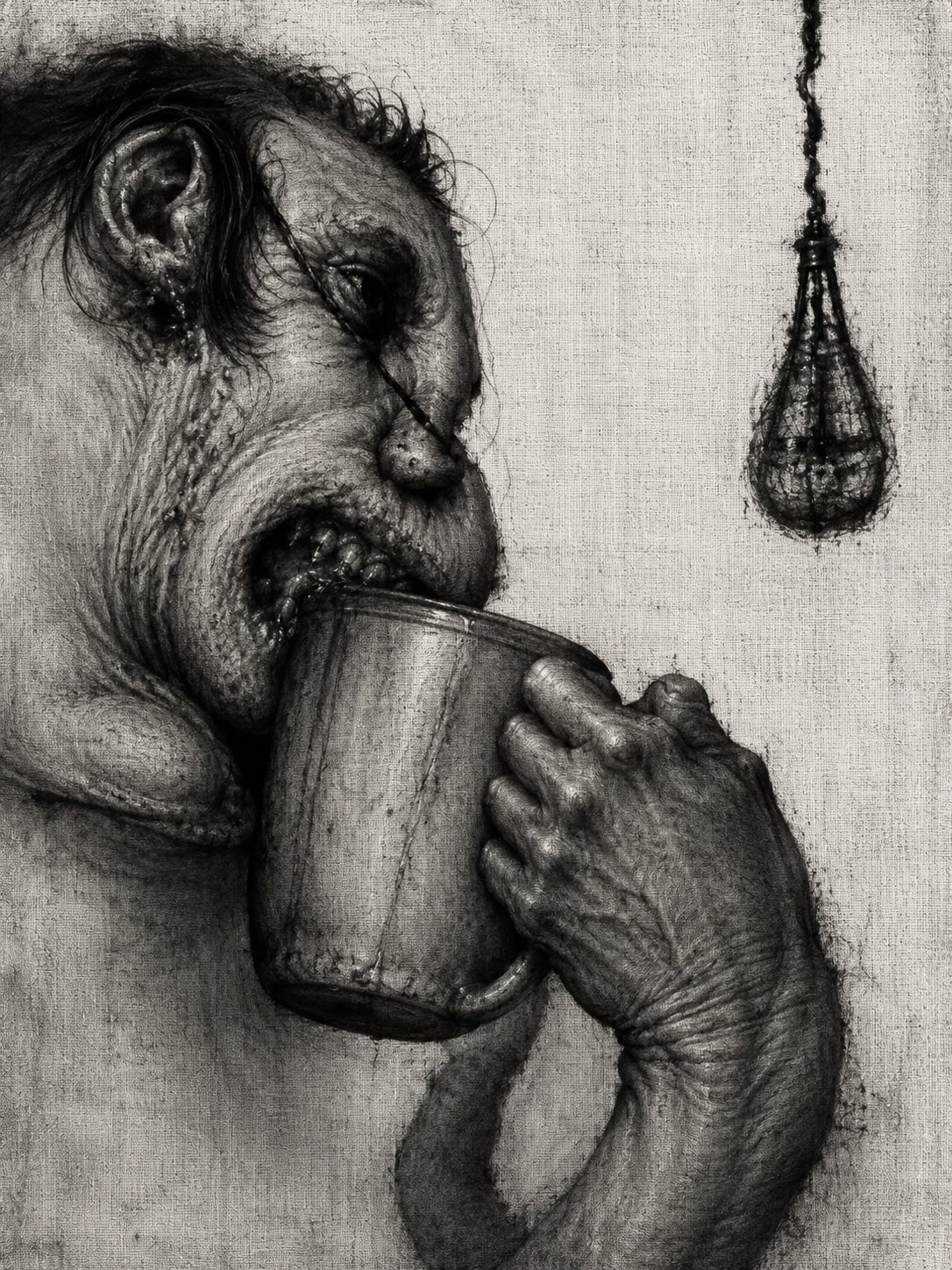
Depression does not always knock on the door wearing black clothes and carrying a violin. Sometimes it enters the kitchen quietly and ruins your tea.
That is how I often know.
Not always. The mind is not so courteous. But often enough that I have begun to treat certain cups of tea as weather reports from the interior. A proper cup of tea, the kind I actually want to drink, has a private geometry. Water, leaf, milk, sugar, time. Too much of one thing and the cup becomes a court case. Too little of another and it becomes brown disappointment wearing steam.
On normal days I know this. My hand knows this. My tongue knows this. Even the cheap saucepan seems to know this, sitting there on the stove like a veteran clerk in a government office, unimpressed but available.
But when the predepression fuse has been lit, the whole operation changes.
I do not make tea then. I commit tea.
I throw in too much milk. I forget the leaf. I add sugar as if I am paying ransom. I let the water boil with the blank aggression of a man watching bad political news on his phone at eleven in the morning while one eye twitches and the ceiling fan rotates like a tired philosophical argument. The final product arrives in the cup with all the charm of a minor railway accident.
You may ask, quite reasonably, why a middle-aged Bengali man from the outer, less photogenic edges of Calcutta is diagnosing himself through tea.
Fair question.
The answer is that the mind gives small warnings before it gives large ones. Not grand cinematic warnings. No thunder. No background score. No wise elderly neighbor looking into the distance and saying, “Something is coming.” The warning is usually domestic. A bad cup of tea. A message left unanswered. A sentence read six times without entering the brain. A sudden irritation at a harmless sound. A shoe placed in the wrong corner and somehow experienced as evidence that civilization has failed.
This is where my depression becomes almost bureaucratic. It files little memos.
The first memo says: attention is fraying.
The second says: sequence is breaking.
The third says: your thoughts have found an old drain and are now circling it with municipal dedication.
By then the upstairs portion of the mind, the part that watches the rest of the mind, wakes up and says, “Ah. So we are doing this again.”
That watcher is metacognition. A grand word for a simple thing: the mind noticing its own tricks. I picture it as a thin, bespectacled clerk in a half-lit room, surrounded by damp files, saying, “Excuse me, but the owner of this establishment appears to be going slightly off the rails.” He is not dramatic. He has seen things. He has watched me open the fridge and stare at a bottle of water as if it contains the lost constitution of Rome.
Still, he is useful.
Because bipolar depression, at least in my case, is not a neat little sad mood with a beginning, middle, and end. It is more like Calcutta traffic after a sudden shower. Everything is technically still moving, but not in any way that would comfort a sane engineer. A bus is angled like a philosophical objection. A scooter is trying to become liquid. A cow, because Calcutta has its own editorial policy, is considering the matter calmly from the side.
My bipolar condition is mostly depressive. That is important because the word bipolar makes people imagine some glittering opposite of sadness: fireworks, wild confidence, a person announcing at breakfast that he has discovered a new empire and ordered shoes accordingly.
That has not been my usual circus.
My upper moods, when they come, are often not joy. They are petrol fumes. Anxiety. Irritation. Agitation. Anger with no proper address. The mind becomes hot and fast, but not usefully fast. Not “let us clean the room and write a brilliant essay” fast. More like “why is this spoon making a sound and who authorized the neighbor’s pressure cooker” fast.
It is a cheap kind of electricity.
Depression, strangely, is sometimes more honest with me. It pays the metacognitive clerk a tip. It leaves clues. It changes the color of the afternoon. It turns ordinary tasks into furniture too heavy to move. It makes the future look not tragic exactly, but unavailable, as if someone has pulled down the shutters and gone for lunch without saying when he will return.
Agitated hypomania is more slippery. It arrives dressed as truth.
It says, “You are not irritable. You are merely correct.”
This is the dangerous joke.
When the brain is changing state, it does not send a neat label. It sends a mood and then forges evidence to support it. Depression says life is pointless, and immediately supplies old memories, unpaid bills, professional disappointments, the declining price of dignity, and three awkward conversations from 1998. Anxiety says danger is coming and produces a full committee report. Irritation says the world is unbearable and points to the neighbor’s drilling machine, the barking dog, the phone notification, the rising price of vegetables, and the fact that the tea tastes like it was assembled by a frightened apprentice in a blackout.
And here is the little horror: it all feels true.
Not poetic true. Official true.
A person outside this machinery may say, “Distract yourself.” Sensible. Also, at times, about as helpful as advising a drowning man to consider water as a concept. Attention is not a switch. It is a small animal. When well-fed and calm, it sits beside you and follows your finger across the page. When frightened, it bolts under the bed and refuses all negotiations.
This is why reading becomes strange before depression fully arrives. I love reading because it allows me to stop, circle a word, admire a sentence, argue with the author, travel backward, travel forward, and sit quietly inside another mind without paying rent. But during the predepression weather, the page becomes slippery. The sentence does not hold. Meaning arrives at the eye and refuses to go upstairs.
You read the same line again.
Then again.
Then you realize you are not reading. You are moving your eyes across print as a priestless ritual. Even an atheist may have rituals. Mine just do not come with incense unless the mosquito coil is misbehaving.
The tea belongs to that same family of warnings. It is not medical proof. No MRI will show “patient added milk like a man fleeing litigation.” No doctor will ask for the viscosity of your morning cha. But private life has private instruments. A musician hears when the string is off. A cook knows when the salt is wrong. A solitary man in a rented room knows when his tea has stopped being tea and become a small brown confession.
There are other signs.
The phone becomes too heavy.
Bathing becomes a project requiring parliamentary approval.
The future shrinks from landscape to corridor.
The room gathers evidence against you.
A plastic chair looks accusatory.
YouTube becomes a swamp where you enter looking for one song and emerge forty minutes later knowing the latest outrage, the newest war rumor, the price of some gadget you cannot buy, and the opinion of a man in a studio who appears to have been angry since birth.
Meanwhile, outside, Calcutta continues in its heroic, foolish, fragrant way. Someone is selling bananas with the confidence of a finance minister. Someone is arguing about politics near a tea stall. Someone is dragging a gas cylinder with the solemnity of a funeral procession. A child is shouting. A pressure cooker whistles. The air smells of dust, frying oil, damp clothes, and the faint metallic promise of rain that may or may not come, because the sky here enjoys suspense.
And inside this ordinary day, the mind begins to misbehave.
That contrast is the thing people miss.
Depression is not only lying in bed like a tragic painting. It is also standing in a kitchen in shorts, making terrible tea, while life around you carries on with the vulgar confidence of a bus conductor. People need change for ten rupees. The milk packet must be cut. The floor must be swept. Work messages may arrive. The world does not pause for your nervous system. It barely pauses for cyclones.
There is shame in this. Of course there is.
Shame arrives quickly in lower-middle-class life because everything is already close to the bone. Money, reputation, stamina, employability, family expectation, rent, medicine, food, the electricity bill, the phone recharge. There is not much velvet padding. A depressive episode does not fall onto a mattress. It falls onto cement.
So when you cannot do small things, the failure feels large.
Could not make tea properly.
Could not answer a message.
Could not work at full speed.
Could not turn education into security.
Could not turn foreign experience into a stable chair under the backside.
Could not be cheerful in the great marketplace of cheerful lies.
Shame then does what shame always does. It opens a shop inside the head and sells you your own life at a discount.
This is why I try, when I can, to notice without immediately prosecuting myself. Not always successfully. I am not a monk. I am a 51-year-old single Bengali man living in the less brochure-friendly parts of Calcutta, where the fan makes a tired clicking sound and the day often begins with the question, “What fresh nonsense now?” But I try.
The bad tea is not a verdict.
It is a signal.
A signal is smaller than a verdict. That distinction can save a morning.
If I say, “I am failing again,” the day becomes a courtroom. If I say, “The tea is bad, and bad tea often comes when the mind is entering fog,” then the day becomes a workshop. Not a pleasant workshop. More like one of those old repair shops where every tool has been touched by grease and the owner knows exactly which wire to jiggle. But still, a workshop.
Something can be done there.
Not everything. Let us not become motivational salesmen. Those fellows can turn even misery into a subscription plan. Bipolar depression is not defeated by one brave cup of tea and a sunrise quote. Sleep matters. Medication may matter. Therapy may matter. Money matters far more than polite society admits. Work matters. Companionship matters. A less predatory world would also help, but I do not expect delivery by Friday.
Still, something can be done.
Make the second cup slowly.
That is my small, ridiculous instruction to myself.
Stand in the kitchen. Measure the water. Watch the leaf darken. Do not check the phone. Do not solve the future. Do not hold a tribunal about the past. Let the milk enter at the right time. Lower the flame. Smell the thing. Notice whether the hand is shaking from anxiety, caffeine, hunger, or too many tabs open in the skull.
The second cup may also be bad.
This is not a film.
But sometimes it is better. Not excellent. Better. And better is a serious word in a depressive life. Better is a rope thrown three feet, not thirty. Better is the fan still turning. Better is one paragraph read with meaning. Better is not answering every dark thought that knocks. Better is knowing that the mind has weather, and weather, even rotten weather, is not identity.
A storm is not the sky.
A bad cup of tea is not a ruined life.
It is a small brown telegram from the nervous system saying, “Pay attention, old boy. The fuse is lit.”
So I pay attention, when I can. I hold the cup. I taste the evidence. I curse mildly but privately. I look out at the damp, noisy, impossible city where people survive by habit, bargaining, appetite, gossip, debt, tea, and some ancient comic stubbornness no economist has yet measured.
Then I try again.
Leaf. Water. Milk. Sugar. Flame.
Not salvation.
Tea.